GlobalFlex Master’s in Computer Engineering from SDSU
Applications Accepted for:
Fall 2026: Oct 1, 2025 – May 1, 2026
- Overview
- How To Apply
- FAQs
About the GlobalFlex Master’s Degree in Computer Engineering
Are you looking to become a leader in a rapidly growing global field? The SDSU GlobalFlex Master of Science in Computer Engineering offered in partnership with university partners gives you the convenience of completing the first semester on SDSU’s learning platform remotely while interacting with renowned SDSU electrical and computer engineering faculty on a regular cadence.
What is GlobalFlex?
In the GlobalFlex modality, a student completes up to four of the required ten courses online and the remaining in-person. Students will begin the program remotely through SDSU Global Campus’s Learning Management System and later transition to the San Diego campus to complete the remainder of the degree in-person. The program reflects the curriculum, academic standards, and credit structure of the existing SDSU stateside degree program.
This modality is especially designed to accommodate international students living abroad who are seeking flexibility in modality, typically due to international travel limitations, without compromising academic rigor. SDSU will issue 20s and facilitate Optional Practical Training (OPT) applications. The program is eligible for up to three years of STEM OPT under current U.S. Department of Homeland Security regulations.
If a student is unable to travel or secure a visa, two alternative pathways are available:
- Complete the full degree online (subject to course availability), or
- Receive a certificate of completion for partial coursework completed
In all cases, students will receive official SDSU transcripts reflecting their academic records.
The GlobalFlex degree will be offered as a third modality in addition to the fully online program currently offered through SDSU Global Campus a
How Does it Work?
- Complete the first semester with us remotely.
- Attend classes in person on the SDSU campus in sunny San Diego starting with your second semester.
- Earn your master’s in as little as three semesters from a leading U.S. university.
- This unique modality offers significant cost savings for a highly coveted master’s degree from a top U.S. public university.
Additionally, the program offers significant merit-based scholarships, support with I-20 processing, and OPT eligibility for three years. Program graduates also will benefit from the services of SDSU Career Services to help guide their next steps in their careers.
Is This Program Right For Me?
You can leverage your bachelor’s degree in science, technology, engineering, mathematics, or another STEM-related field to qualify for this program. Through proper preparation, students with undergraduate degrees in diverse areas can confidently excel in the SDSU Master of Computer Engineering program.
The accelerated program helps you to prepare for a rapidly growing job market. With a blend of computer science and electrical engineering courses, you will receive broad knowledge of software programming, hardware design, machine learning, embedded systems, and other cutting-edge technologies that align directly with the current industry needs.
The program culminates in a hands-on project designed to demonstrate your progress and mastery of concepts. You’ll complete a project report and present it to your Project Advisor.
Our International Partners
The SDSU GlobalFlex Master of Science in Computer Engineering is offered through partnerships with dozens of international institutions. Contact your institution to confirm if they are partnering with SDSU on the GlobalFlex Master’s in Computer Engineering program.
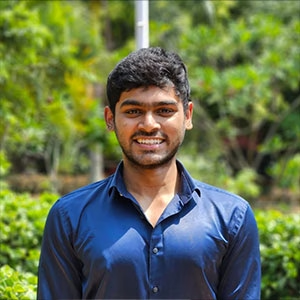
America has always been the land where all dreams come true, and San Diego is ‘America’s Finest City’. For me, it’s the sunshine, the positive attitude that I see in people around me, Aztec games, and the culture, really. Endless possibilities to work hard and play hard.
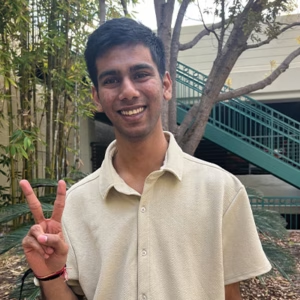
Ever since I was a kid, I used to tell my parents that I dream of coming to the U. S. I want to study here. So they knew about it. And when I heard about GlobalFlex, I thought this is my chance, I have to take it.
Merit-based scholarships are available for up to 40% of the program tuition
30 units (9 courses and 1 project)
International Benefits
- OPT eligible for 3 years
- No GRE requirement
- SDSU processes I-20
- No English language requirement if your undergraduate education medium of instruction was English
Sample Program Schedule
Semester 1
Fall Intake: Aug – Dec
Spring Intake: Jan – May
(Online)
Total Tuition Fee this semester: $10,932
- Database and Web programming
- Computer Networks
- Machine Learning for Engineers
- Advanced Object-Oriented Design and Programming
Semester 2
Fall Intake: Jan – May
Spring Intake: Aug – Dec
(In-Person at SDSU Campus)
Total Tuition Fee this semester: $8,199
- Intelligent Systems
- Artificial Intelligence
- Visual Perception & Learning
Semester 3
Fall Intake: Aug – Dec
Spring Intake: Jan – May
(In-Person at SDSU Campus)
Total Tuition Fee this semester: $8,199
- Embedded Operating Systems
- Accelerated Computing
- Project
Career Outcomes
Most students find careers in either hardware engineering or software engineering. Hardware engineers focus their skills on computer systems and components, designing integrated circuits such as microprocessors, and other embedded devices. Software engineers develop and test programs and applications that run on computing devices.
In these fields, you’ll have a wide range of career options, including:
- Machine Learning
- Object Oriented Programming
- Artificial Intelligence
- Embedded Systems
- Wireless Networks
- Cybersecurity
Labor Analysis
- 503,448Job postings in the last 12 months
- +17.19%Projected job growth over 10 years
- $80,000 – $117,000Average Salary (nationwide)
Source: BLS & Burning Glass Technologies, 2020
Scholarships / Financial Assistance
Deserving students may be eligible for merit-based scholarships ranging from 20% to 40% of the total program tuition. Scholarship decisions are based strictly on academic merit and take into consideration the student’s undergraduate GPA, the rigor and relevance of completed coursework, and any research projects or publications the student may have completed. For additional information on financial loans and other payment options, please visit our Paying for College Tuition page under the section titled “Information for International Students.”
Why Should You Choose Us?
The GlobalFlex Master’s in Computer Engineering at San Diego State University offers a powerful blend of flexibility, rigor, and real-world relevance. Designed for ambitious students worldwide, GlobalFlex allows you to begin your degree online and transition seamlessly to on-campus study, giving you the flexibility to manage visas, costs, and life commitments without compromising academic quality.
The program features cutting-edge coursework across AI, data systems, cybersecurity, networking, and embedded systems, with the freedom to customize your specialization to match your career goals. You will learn from world-renowned faculty actively engaged in research and industry collaboration, while studying in San Diego—one of the nation’s most dynamic technology hubs, home to over 1,800 tech startups alongside global leaders such as FAANG companies.
SDSU’s Masters in Computer Engineering prepares you to graduate not only with an advanced degree, but as a career-ready engineer positioned at the forefront of innovation.
Application Instructions
Applications are open to eligible students in California, across the United States, and internationally.
Out-of-State U.S. Applicants
While we welcome out-of-state students, SDSU Global Campus currently cannot accept applications from students residing in some specific states within the United States. Please check back often, as this list of approved states does change. View the list of authorized states here.
Step 1: Fill out the interest form
Step 2: Review the Program Admission Requirements
Applicants of the GlobalFlex M.S. in Computer Engineering program must meet the following minimum requirements for admission:
- Have earned an acceptable baccalaureate degree earned at an institution accredited by a regional accrediting association in electrical engineering, computer engineering, or another STEM-related field.
- Will have earned an acceptable four-year baccalaureate degree from an institution accredited by a regional accrediting association, by the term immediately prior to enrollment.
- Have attained a grade point average of at least 2.85 (domestic applicants) in an acceptable earned baccalaureate degree, or at least 2.85 in the last 60 semester (90 quarter) units attempted or 3.0 grade point average (international applicants).
- Have been in good standing at the last institution attended.
For universities that issue three-year degrees: Three-year bachelor’s degrees are accepted if all coursework is completed and the final diploma has been issued. Three-year degrees that are in progress will not be accepted.
Step 3: Complete the Cal State Apply Application
Complete the California State University online application on the Cal State Apply website. Submit this application to SDSU before submitting any other documents. The application requires a $70 USD fee that is non-refundable and may not be transferred to another term. When you’re selecting your program in the application, please choose Computer Engineering (Hybrid – GlobalFlex) from the list.
Step 4: Submit Official Academic Records to SDSU Graduate Admissions
Graduate applicants are required to submit official transcripts from all post-secondary schools attended. Do not send transcripts before submitting the Cal State Apply application, as this may result in processing delays.
Transcripts from U.S. Institutions
- Submit official transcripts (in sealed envelopes) from all colleges and universities attended.
- Transcripts must have been issued within the last year. Transcripts received with print dates older than one year will not be accepted.
- Hard copy transcripts for SDSU coursework are not required.
- Electronic transcripts are preferred. Please ensure that you indicate this preference when making your request. If you are required to provide an email address to send the secure online document to SDSU, please use transcriptsforsdsu@sdsu.edu.
Transcripts from International Institutions
If you have international coursework, you are required to submit official transcripts (academic record) and official proof of degree (diploma/degree certificate), both in the original language and a certified English translation, for all post-secondary schools attended. Visit SDSU’s Graduate: Requirements by Country web page and carefully review your country of study to determine the exact academic records SDSU requires in order for you to be considered for admission. Failure to submit the required documents listed will result in the cancellation of your application.
Once Graduate Admissions has received all required documents, your application will be considered complete and will be forwarded to the program you are applying to for consideration. If your country of study is not listed or if you have questions about the documents required of you, please contact documents.global@sdsu.edu for assistance.
- Post-Secondary Transcripts: Official transcripts/grade reports are required from all post-secondary schools attended
- Diploma/Degree Certificate: For each post-secondary degree completed, submit an official copy of your diploma/degree certificate or provisional degree certificate.
- English Translation: For each original-language document, submit an official certified literal English translation. The translation must be from the university or a certified translator and should contain all information shown on the original-language documents in the same format.
Step 5: Submit Proof of English Proficiency (if applicable)
All graduate and post-baccalaureate applicants, regardless of citizenship or native language, who do not possess a bachelor’s degree from a U.S. regionally accredited institution or from a country whose official/primary language is not English must submit one of the following:
- TOEFL minimum score of 80 iBT/ 550 PBT.
- IELTS overall score of 6.5 or higher.
- Duolingo English Test score of 105 or higher. Please note Duolingo is not acceptable for applicants to joint doctoral programs.
- PTE minimum score of 58 or higher.
- Test scores must be from within the past two years.
Test scores must be dated within two years of the start of the application filing period. Official test scores can be sent directly from the testing agency to SDSU. Select SDSU as the recipient when sending the scores through the testing agency account.
English Proficiency Waivers
English Proficiency requirements can be waived if you earned or have a Bachelor’s degree from an international post-secondary institution where English was the principal language of instruction.
- Options to waive requirement*:
- Transcripts and grade reports must list English as the medium of instruction or
- Provide a certified letter from the institution confirming courses were taught in English. The letter must be sent from the institution to SDSU.
The English proficiency requirement will be waived upon receipt of an official transcript verifying the applicant meets one of the listed conditions.
*Applicants from the following qualifying countries will be automatically exempt from the English proficiency requirement: American Samoa, Antigua & Barbuda, Australia, Barbados, Belize, Botswana, British Virgin Islands, Canada (except Quebec), Falkland Islands, Gambia, Ghana, Gibraltar, Guam, Guyana, Ireland, Jamaica, Liberia, Malta, Marshall Islands, Micronesia, New Zealand, Nigeria, Northern Mariana Islands, Palau, Papua New Guinea, Saint Kitts & Nevis, Saint Lucia, Saint Vincent & the Grenadines, Sierra Leone, Singapore, Trinidad & Tobago, Uganda, United Kingdom, Virgin Islands, Zambia, Zimbabwe.
How to Submit Your Documents
Graduate applicants may submit their official academic records to SDSU in one of the following options:
- Option 1: Official Documents Electronically — Submit official academic records via email. For colleges and universities that offer the option to send transcripts either electronically or by mail, electronic submission is preferred. If an email address is required when ordering an electronic transcript for SDSU, please use TranscriptsForSDSU@sdsu.edu. To be considered official, academic documents must be sent directly by the university Registrar or Controller of Examinations. Copies emailed by students will not be accepted.
- Option 2: Official Documents by Mail—Submit official documents in a sealed/unopened envelope, stamped or signed by the appropriate official from the issuing institution. Please do not send the only original academic record(s) and/or diploma(s)/degree certificate(s). All documents received become the property of SDSU and will not be returned.
If mailing international documents, we recommend using guaranteed delivery services such as Federal Express or DHL. This allows you to track and confirm delivery of your documents to Graduate Admissions.
Graduate Admissions
San Diego State University
5500 Campanile Drive
San Diego, CA 92182-8225
- Option 3: Evaluation Report —Applicants with international coursework may submit a foreign evaluation report from one of the following:
The evaluation report must be sent electronically, directly by IERF or WES to Graduate Admissions, must include copies of the international documents used to complete the evaluation, and the report date must be issued within one year.
Step 6: Review Your Application Status
After submitting the online Cal State Apply application, you will receive an email from San Diego State University that includes your SDSUid, which is needed to log into my.SDSU. You can use my.SDSU to check your application and admission status. Please check back frequently to make sure all of the required materials have been received — you’re responsible for ensuring that all supporting materials are submitted by the posted deadline.
Allow at least three weeks for processing after documents have been submitted to the Graduate Admissions Office. The status of documents and test scores will be updated in your my.SDSU account after they have been evaluated by the SDSU Graduate Admissions Office. Please do not submit your documents multiple times, as this will cause delays in processing.
Scholarships
All admitted students will be considered for merit-based scholarships based on their academic performance, and notifications will be sent via email.
Admission and General FAQs
SDSU allows two intakes per year, a Spring intake in January and a Fall intake in August.
The Degree of Master of Science in Computer Engineering will be awarded by San Diego State University (SDSU), California, USA.
A color scan of the below-mentioned original document is required to be uploaded on the admission portal at the time of seeking admission:
- Transcript of all the semesters of bachelor’s degree coursework
- Degree Certificate / Provisional Degree Certificate
- If the language of instruction in the undergraduate degree program is not English, then a score of English Proficiency Test is required.
You must have a minimum GPA of 3.0 on a scale of 4.0.
If the language of instruction in the undergraduate degree program is English, then no language proficiency test scores are needed.
No. The GRE Score requirement has been waived.
Yes, provided the student completes the foundation program facilitated by either SDSU or the local University in your home country.
Yes. The GPA from the previously completed semester will be taken into consideration and a conditional offer of admission will be made.
Yes. The Program is accredited by the Chancellor’s Office of the California State University and further by The Accrediting Commission for Schools, Western Association of Schools and College (ACS WASC).
Yes. If you enroll in the GlobalFlex program, you will be awarded the same degree certificate as the students pursuing the same in-person program on the SDSU campus.
The minimum duration of the program is three semesters.
The program will commence in August 2025.
Semester – I: August 2025 – December 2025 (Home Country Campus)
Semester – II: January 2026 – May 2026 (SDSU Campus, USA)
Semester – III: August 2026 – December 2026 (SDSU Campus, USA)
Usually, it takes between 8 to 12 weeks to get an admission decision. However, students applying to the GlobalFlex program are assured of admission if they satisfy the minimum eligibility requirements and have the entire application process completed within about 2 weeks from completing the entire admission package.
Since this is a STEM Program, students can apply to receive up to 36 months of OPT employment authorization.
The office of Career Services will assist students with resume preparation, interview skills, and networking opportunities, besides identifying job openings. The International Student Center (ISC) at SDSU will assist the students with filing the OPT.
Yes. A student is permitted to work part-time for up to 20 hours per week on campus. The student is also eligible for summer internships off-campus for 40 hours per week.
The process for applying for visa commences immediately after the student has accepted the admission offer. All possible assistance will be extended to students for Form I-20. The International Student Center (ISC) will assist students with this process.
Yes. SDSU will assist and connect the student with the local representative to identify suitable student accommodation as per budget.
The tuition fee is $911 US per credit. Please contact the admission counselor for more details regarding fees and installments.
Yes. Deserving students have an opportunity to earn scholarships between 20% to 40% of the total tuition cost of the program. The scholarship criteria is strictly merit-based and will take into consideration the student’s undergraduate GPA, the kind of coursework completed in the undergraduate programs, and any research project or publication that the student may have completed. For additional information on financial loans, please consult our Paying for College Tuition page.
Academic FAQs
9 courses +1 Project
30 credits
A 3-credit course over a 16-week semester requires approximately 9 hours of work in some combination of class instructional time and independent study time.
Each 3-credit course will have approximately 45 hours worth of lecture content.
In the second semester.
The choice of courses is to be indicated before the commencement of the corresponding semester. Visa rules require that you be enrolled in a minimum of 9 credits (or units) which is equal to 3 courses for this program (since each course is worth 3 credits) in each semester.
Yes, electives can be changed with the approval of the Faculty Director and Advisor, given that the course has seats available.
It is a platform (software) through which program delivery and administration is managed. The learner will be provided with a login ID and password to access the LMS. The LMS will provide the learner with access to study material, recordings of live sessions, pre-recorded videos, discussion, and chat facilities to interact with the faculty and clear doubts. The LMS will also contain information about class schedule, course information, and other announcements.
Both the matrix and syllabus are available on the LMS and the catalog on the program website.
A Semester-wise Calendar of Events is available on the LMS. Moreover, SDSU has a website that showcases the academic calendar with all campus holidays and important academic deadlines: https://registrar.sdsu.edu/calendars/academic
Yes. All live online sessions will be recorded and available on the LMS.
Yes. A learner is provided access to an exhaustive and customized Self Learning Material (SLM) on the LMS.
The assessment in courses may be comprised of quizzes, coding assignments, reading assignments, mid-term assessments, and final examinations. The faculty will indicate the specifics at the commencement of the course.
Yes. A laptop computer with a working webcam & microphone facility is required.
About SDSU
San Diego State University is located in Southern California in the beautiful city of San Diego, California, USA. It is the flagship campus of the 23 California State University (CSU) campuses and ranked #15 among all public universities in the U.S. in 2022-2023. Since its founding in 1897, the university has grown to become a leading public research university. Each year, SDSU provides more than 36,000 students with the opportunity to participate in an academic curriculum distinguished by direct contact with faculty and an international emphasis that prepares them for a global future.
Collaborators


